
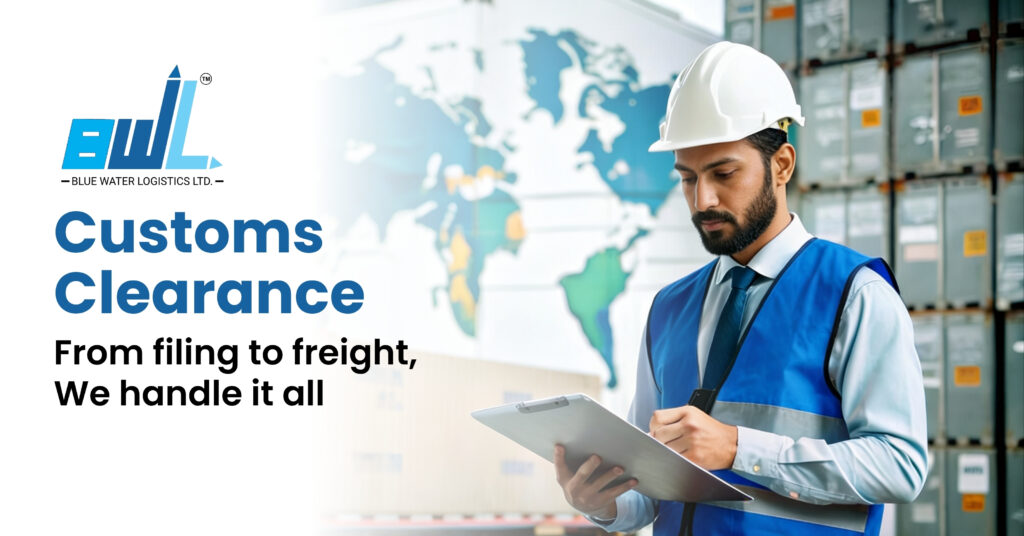
Every time a shipment crosses an international border, whether it’s a container of chemicals heading to Rotterdam, a pallet of pharmaceuticals bound for Singapore, or a consignment of auto parts entering India, it must pass through customs. This process, known as customs clearance, is the official procedure by which a government authority permits goods to enter or exit the country.
For businesses involved in international trade, customs clearance is one of the most critical steps in the entire supply chain. A single missing document, an incorrect HS code, or an undeclared item can result in your cargo being held at the port for days — or worse, seized, returned, or penalised.
At Blue Water Logistics, customs clearance is not just a service we offer. It is a core competency we have built over 15 years of working with exporters and importers across India’s most complex trade corridors.
Understanding the clearance process helps businesses plan better, avoid delays, and build more efficient supply chains. Here is how it works from start to finish:
Step 1 — Arrival & Entry Filing Once cargo arrives at the port of entry, an Entry (Import General Manifest or Export Shipping Bill) is filed with customs. This is the formal declaration that initiates the clearance process. Accuracy at this stage is everything — errors here cascade through the entire process.
Step 2 — Document Submission & Verification Customs officers review all submitted documents — commercial invoice, packing list, Bill of Lading or Airway Bill, Certificate of Origin, and any licences or permits required for the specific cargo type. Each document must be consistent, accurate, and complete.
Step 3 — Duty Assessment & Payment Based on the declared HS (Harmonised System) code and declared value of the goods, customs calculates the applicable import duty, GST, and other levies. These must be paid before the cargo is released. Correct HS code classification is critical — errors here directly affect the duty amount and can trigger audits.
Step 4 — Physical Examination (if required) Depending on the nature of the cargo, its origin, or risk profiling by customs, a physical examination may be ordered. This involves customs officers inspecting the actual goods to verify the declaration. Having an experienced CHA (Customs House Agent) present during examination is strongly advised.
Step 5 — Release & Out-of-Charge Order Once duties are paid, documents verified, and examination completed, customs issues an Out-of-Charge order. This is the green light, your cargo is cleared and can now move to its final destination.
Documentation is the backbone of customs clearance. Missing or incorrect documents are the single most common reason for shipment delays at Indian ports. Every importer and exporter must have these in order:
While both follow the same broad framework, import and export customs clearance have distinct requirements, timelines, and regulatory considerations.
Export Customs Clearance Export clearance in India is processed through the ICEGATE portal, where an exporter or their CHA files a Shipping Bill. Once the Let Export Order (LEO) is issued, the cargo is cleared for loading. For exporters, the focus is on correct documentation, compliance with export control regulations, and ensuring eligibility for duty drawback or GST refund entitlements.
Import Customs Clearance Import clearance involves filing a Bill of Entry — either for home consumption or for warehousing in a bonded facility. Import clearance is typically more complex, involving duty assessment, potential physical examination, and compliance with multiple regulatory bodies depending on the nature of the goods — FSSAI for food, CDSCO for pharma, BIS for standardised products.
BWL began its journey as a licensed Customs House Agency — which means customs clearance is not a service we added later. It is where we started. That heritage gives our team a depth of knowledge, port-level relationships, and regulatory fluency that generalist freight forwarders simply cannot match.
Founded as a CHA : Customs is our origin. Deep regulatory expertise built from the ground up, one shipment at a time.
Zero-Delay Focus : We review documentation proactively before filing, not after a query is raised by customs.
Hazardous Cargo Specialist : Chemicals, ISO tank cargo, dual-use goods — we handle the complex consignments others avoid.
Pan-India Port Coverage : Active at all major Indian ports and ICDs, from Nhava Sheva to Visakhapatnam.
End-to-End Visibility : You know your clearance status at every step, in real time.
Multimodal Integration : Customs clearance seamlessly connected to onward sea, air, or road logistics, all under one roof.
Customs clearance is not the most glamorous part of global trade — but it is often the most consequential. A shipment that is prepared correctly, documented thoroughly, and handled by the right partner clears without friction. One that isn’t can cost you time, money, and client trust.
At Blue Water Logistics, we have built our reputation on getting this right — every time, for every client, at every port. Because when your cargo moves without delay, your business moves forward.
That is the BWL promise. And we never miss a delivery.
BLUE WATER LOGISTICS LIMITED
(Formerly known as Blue Water Logistics Private Limited)
CIN No: L63030TG2022PLC165815
H NO.8-2-270/B/1/2, Block-3, 4th Floor Uptown Banjara, Road No.3, Banjara Hills, Hyderabad, Telangana, India, 500034