
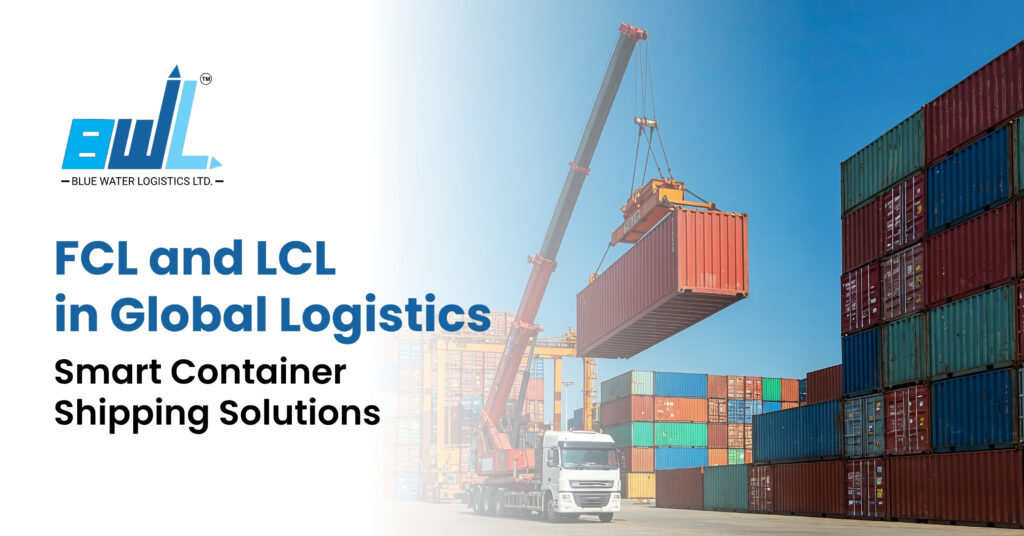
In the world of international shipping and freight forwarding, businesses often encounter two important logistics terms FCL (Full Container Load) and LCL (Less than Container Load). Both are widely used methods for transporting cargo across global supply chains, and selecting the right option can significantly impact shipping costs, cargo safety, delivery timelines, and overall operational efficiency.
As global trade continues to expand, businesses require logistics solutions that are flexible, reliable, and cost-effective. Whether a company is moving large industrial cargo or smaller commercial shipments, understanding the difference between FCL and LCL helps in making smarter shipping decisions.
FCL, or Full Container Load, refers to a shipment where an entire shipping container is used exclusively by a single customer. In this method, the container carries cargo belonging to only one shipper, regardless of whether the container is fully packed or partially filled.
FCL is commonly used when businesses have large shipment volumes that can utilize most or all of a container’s capacity. It is one of the most preferred shipping methods for exporters and importers handling bulk cargo, industrial goods, machinery, raw materials, or high-volume commercial products.
Since the container belongs to one customer throughout the journey, the cargo remains sealed from origin to destination, ensuring better security and reduced handling risks.
FCL shipments generally move faster because the container does not need consolidation or deconsolidation with other shipments. This reduces delays during loading and unloading processes at ports and warehouses.
Since the container is dedicated to a single shipment, the cargo faces minimal handling during transit. This lowers the chances of cargo damage, contamination, or misplacement.
Businesses transporting high-volume goods benefit greatly from FCL because it provides dedicated container space and improved operational efficiency.
With fewer handling stages and no dependency on multiple consignments, FCL shipments usually experience smoother movement across supply chains.
For larger shipments, FCL often becomes more economical compared to paying for shared container space through LCL shipping.
LCL, or Less than Container Load, is a shipping method where multiple shipments from different customers are consolidated into a single container. Each customer pays only for the space occupied by their cargo instead of booking the entire container.
LCL is highly suitable for businesses with smaller shipment volumes that do not require full container capacity. It provides an affordable and flexible solution for small and medium-sized enterprises looking to participate in global trade without incurring the cost of a dedicated container.
In LCL shipping, cargo from various shippers is grouped together at a consolidation warehouse before being loaded into a shared container for transportation.
LCL allows businesses to ship smaller cargo quantities without paying for an entire container, making international shipping more affordable.
Businesses can move cargo more frequently instead of waiting to accumulate enough goods to fill a full container.
LCL enables smaller businesses and growing enterprises to participate in international trade efficiently and economically.
By sharing container space with multiple shippers, LCL maximizes transportation efficiency and minimizes unused cargo space.
Frequent smaller shipments help businesses manage inventory better and reduce storage costs.
Although both methods serve the same purpose of transporting cargo internationally, they differ in several important areas.
|
Feature |
FCL |
LCL |
|
Container Usage |
Entire container for one customer |
Shared container space |
|
Shipment Volume |
Large cargo volumes |
Smaller cargo volumes |
|
Transit Time |
Faster |
Slightly longer |
|
Cargo Handling |
Minimal handling |
More handling during consolidation |
|
Cost Structure |
Cost-effective for bulk cargo |
Cost-effective for smaller shipments |
|
Security |
Higher cargo security |
Shared container environment |
FCL is generally the better choice when:
Industries such as manufacturing, chemicals, automotive, industrial equipment, and retail often rely on FCL shipping for efficient cargo movement.
LCL is the ideal option when:
LCL is widely used for commercial goods, consumer products, sample shipments, and smaller export consignments.
Choosing between FCL and LCL is not only about container size, it is also about logistics planning, cargo type, delivery timelines, and supply chain strategy.
Efficient freight forwarding partners help businesses:
Proper planning helps businesses reduce delays, avoid unnecessary expenses, and improve overall supply chain performance.
Containerized cargo movement has transformed global trade by improving cargo security, transportation efficiency, and international connectivity. Both FCL and LCL play a major role in supporting global commerce by helping businesses move goods across countries and continents smoothly.
As industries continue expanding internationally, the demand for reliable container shipping solutions continues to grow. Businesses today require logistics partners capable of providing flexible and scalable shipping solutions that align with changing trade requirements.
FCL and LCL are two essential shipping methods that support global cargo movement across international supply chains. While FCL offers speed, security, and efficiency for large-volume cargo, LCL provides flexibility and affordability for smaller shipments.
The right choice depends on shipment size, cargo nature, transit urgency, and budget considerations. Understanding these shipping solutions helps businesses improve operational efficiency, optimize transportation costs, and build stronger global logistics strategies.
In modern logistics, efficient cargo movement is not just about transportation it is about selecting the right shipping solution for every business requirement.
BLUE WATER LOGISTICS LIMITED
(Formerly known as Blue Water Logistics Private Limited)
CIN No: L63030TG2022PLC165815
H NO.8-2-270/B/1/2, Block-3, 4th Floor Uptown Banjara, Road No.3, Banjara Hills, Hyderabad, Telangana, India, 500034