
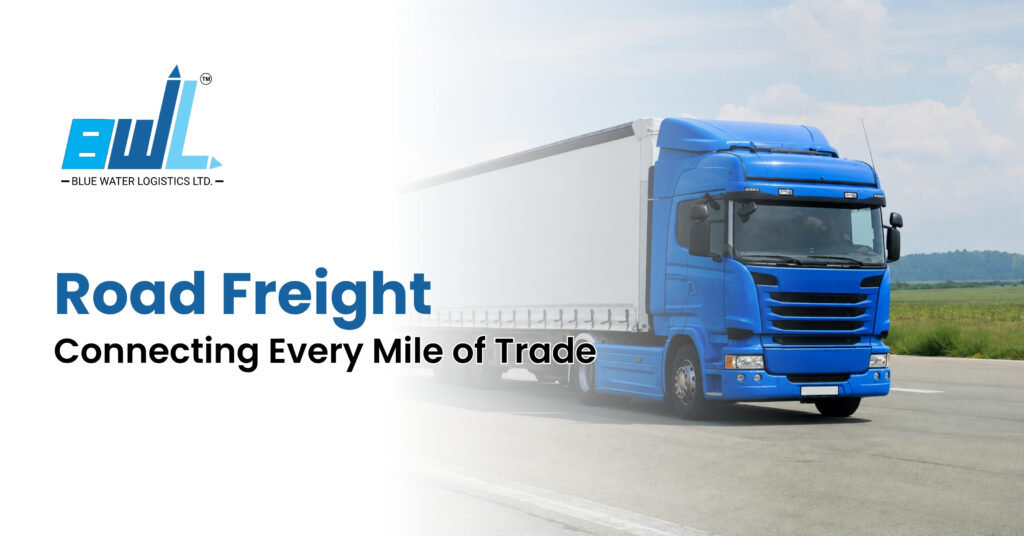
Road freight plays a critical role in global logistics by connecting ports, warehouses, distribution centres, businesses, and final destinations. While ocean and air freight enable long distance movement, road transportation often completes the crucial first and last mile.
For businesses, reliable road freight is not simply about moving cargo from one location to another. It is about ensuring that shipments move safely, efficiently, and on schedule across every stage of the supply chain.
Road freight refers to the transportation of goods by trucks and other road vehicles.
It can support a wide range of shipments, from individual consignments and containerized cargo to industrial equipment, project cargo, and time sensitive deliveries.
Road freight can operate as a standalone transportation solution or as part of a multimodal logistics network connecting with sea, air, and rail transportation.
Most supply chains involve multiple transportation points. Cargo may begin at a manufacturing facility, move to a warehouse, reach a port, and then continue to its final destination.
Road freight connects these points.
Some of its key advantages include:
This connectivity makes road freight an essential part of modern supply chains.
One of the most important roles of road freight is connecting the beginning and end of a shipment’s journey.
First mile transportation moves cargo from the supplier, manufacturer, warehouse, or other origin point to the next stage of the logistics network.
For international shipments, this could mean transporting cargo from a factory to a port or container terminal.
Last mile transportation moves cargo from a port, warehouse, distribution centre, or terminal to its final destination.
This stage can have a direct impact on delivery timelines and customer satisfaction, making reliable coordination especially important.
Road transportation becomes even more valuable when integrated with other modes.
A typical international shipment could involve:
Road → Sea → Road
Cargo may be collected from the origin facility, transported by truck to a port, shipped internationally by sea, and then moved by road from the destination port to the final delivery point.
Similarly, urgent cargo could follow:
Road → Air → Road
Here, road transportation connects the shipment to and from the airport while air freight handles the long distance movement.
This integration allows businesses to select the most appropriate transportation mode for each stage of the journey.
Road freight is widely used for moving shipping containers between ports, terminals, warehouses, and industrial facilities.
Container trucking requires coordination between the carrier, terminal, warehouse, consignee, and other stakeholders.
Important considerations can include:
Effective coordination helps reduce unnecessary waiting time and keep cargo moving through the supply chain.
Not every shipment can be transported using a standard truck.
Oversized, heavy, hazardous, or specialized cargo may require specific vehicles, equipment, permits, and handling procedures.
For such shipments, logistics planning becomes particularly important.
The transportation team may need to evaluate:
A properly planned road movement can help reduce operational risks while maintaining control over the shipment.
Reliable road freight depends on more than having a fleet of vehicles.
Selecting suitable routes can help manage travel time, road restrictions, congestion, and delivery requirements.
The right vehicle needs to be available at the right location and time.
Tracking cargo movement allows logistics teams and customers to stay informed about delivery progress.
Experienced drivers and logistics teams play an important role in handling cargo safely and responding to operational challenges.
Road transportation involves multiple moving parts. Clear communication between the shipper, carrier, terminal, warehouse, and consignee helps keep operations aligned.
Road freight can also support cross border transportation, where additional planning may be required.
International road movements may involve customs documentation, border procedures, permits, cargo regulations, and coordination between different logistics networks.
A logistics partner with experience in cross border transportation can help coordinate these requirements and reduce unnecessary delays.
The right road transportation solution depends on several factors:
Cargo: What is being transported?
Distance: How far does it need to travel?
Timeline: How quickly does it need to arrive?
Vehicle: What type of truck or equipment is required?
Route: Are there restrictions or special requirements?
Destination: Can the delivery location accommodate the vehicle and cargo?
Understanding these factors before transportation begins allows businesses to build a more efficient movement plan.
As supply chains become increasingly interconnected, road freight continues to serve as the link between different transportation modes.
Ports need trucks to move containers. Airports need road transportation to connect cargo with businesses. Warehouses depend on road networks for inbound and outbound movement.
In this way, road freight does more than transport cargo. It connects the different stages of the supply chain.
Road freight remains a fundamental part of modern logistics because of its flexibility, accessibility, and ability to connect businesses with ports, warehouses, terminals, and final destinations.
Whether it is a local delivery, container movement, cross border shipment, or part of a larger multimodal transportation plan, reliable road freight helps keep cargo moving.
When every stage of the supply chain needs to stay connected, road freight provides the link that keeps the journey moving.
BLUE WATER LOGISTICS LIMITED
(Formerly known as Blue Water Logistics Private Limited)
CIN No: L63030TG2022PLC165815
H NO.8-2-270/B/1/2, Block-3, 4th Floor Uptown Banjara, Road No.3, Banjara Hills, Hyderabad, Telangana, India, 500034