
Most shipments that get rejected at a foreign port are not rejected for the reason the exporter expects. The cargo is fine. The documentation for the cargo is fine. The problem is the pallet it is sitting on.6385072830
Fumigation is the least discussed stage of the export process and one of the few that can invalidate an entire consignment after it has already crossed an ocean.
Every country regulates what crosses its border, and that regulation extends well beyond the goods themselves. Wood packaging material — pallets, crates, dunnage, bracing — can carry insect larvae, fungi and wood-boring pests. Introduced into a new ecosystem, those organisms have caused agricultural damage on a scale that has justified some of the strictest import rules in world trade.
The international response is ISPM 15, a standard requiring that solid wood packaging used in international shipping be heat-treated or fumigated and marked accordingly. Agricultural cargo carries its own additional requirements, which vary considerably by destination.
Treating the cargo and forgetting the packaging. An exporter arranges fumigation for an agricultural consignment and overlooks the untreated wooden pallets underneath it. The cargo complies. The shipment does not.
Assuming one destination’s rules apply everywhere. Australia, New Zealand, the United States and the European Union each apply different thresholds and different documentation expectations. A treatment that satisfied a Gulf buyer last quarter may not satisfy an Australian one this quarter.
Treating too early or too late. Fumigation certificates carry validity windows. A treatment performed well in advance of a delayed dispatch can expire before the vessel sails, leaving the exporter with a certificate that no longer covers the shipment it was issued for.
Each of these is discovered at the destination, which is the most expensive possible place to discover it.
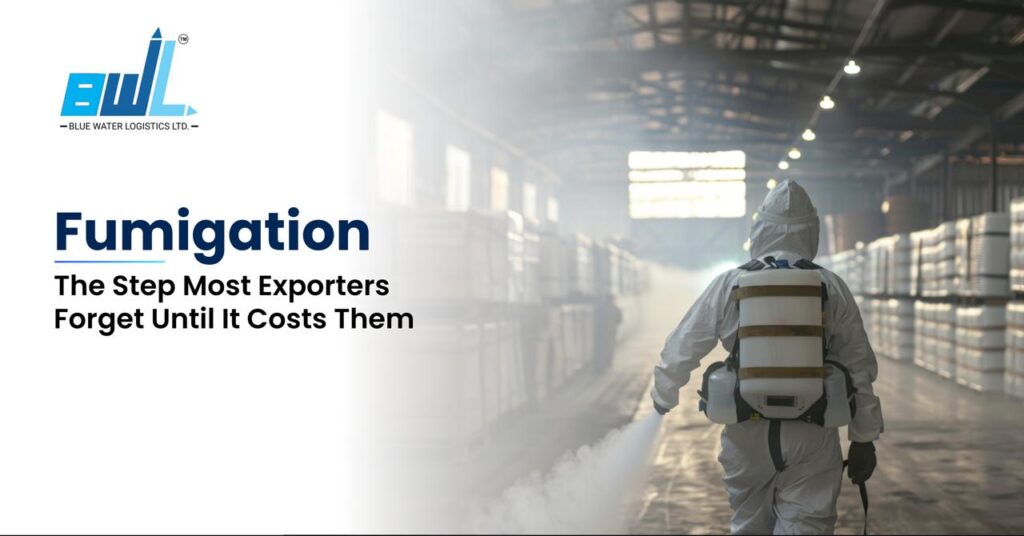
The process is straightforward when it is planned and difficult when it is rushed. Cargo or packaging is sealed and treated with an approved fumigant — methyl bromide and phosphine are the most common — at a specified concentration, for a specified exposure period, at a temperature that keeps the treatment effective. The space is then ventilated to safe levels before handling resumes.
A licensed operator issues a fumigation certificate recording the treatment method, dosage, duration, date and the identity of the cargo treated. That certificate travels with the shipping documents. Where wood packaging is involved, the ISPM 15 stamp must be physically present on the material itself.
Exposure time and ventilation cannot be compressed to fit a dispatch schedule. Which is precisely why fumigation belongs in the shipment plan rather than at the end of it.
Fumigation is not a difficult requirement. It is a requirement that fails when it is treated as an afterthought — booked in the final days before dispatch, arranged separately from the rest of the shipment, checked against last year’s destination rules.
Blue Water Logistics handles fumigation as part of an integrated export process, planned alongside packaging, palletisation and customs documentation rather than bolted on at the end. For agricultural, perishable and wood-packaged cargo, that sequencing is often the difference between a shipment that clears and one that comes back.
Planning an export consignment? Talk to our team → bwl.co.in/contact-us
BLUE WATER LOGISTICS LIMITED
(Formerly known as Blue Water Logistics Private Limited)
CIN No: L63030TG2022PLC165815
H NO.8-2-270/B/1/2, Block-3, 4th Floor Uptown Banjara, Road No.3, Banjara Hills, Hyderabad, Telangana, India, 500034