
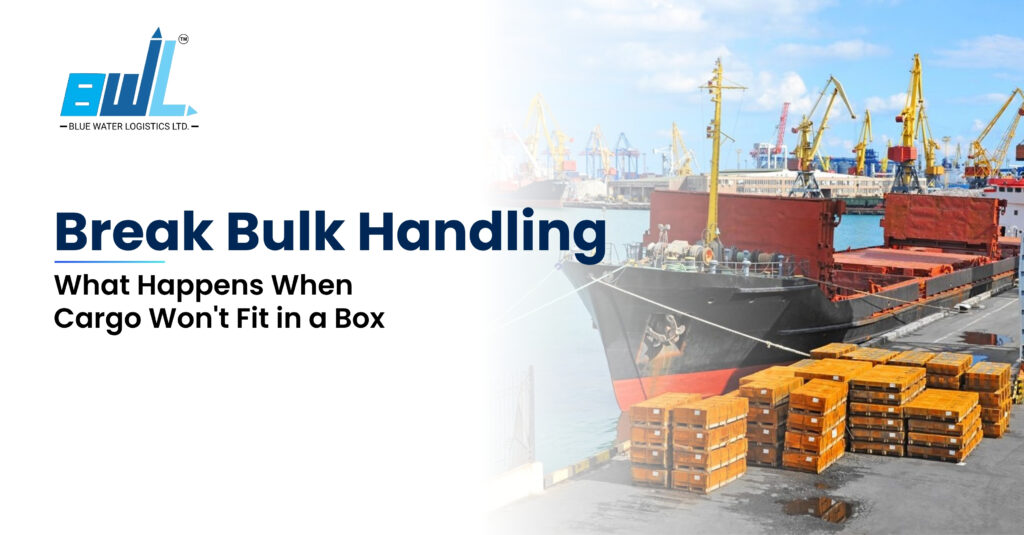
A wind turbine blade is longer than any container manufactured. A refinery vessel is heavier than any container is rated to hold. A transformer, a ship’s propeller, a pre-assembled production line — none of these were designed with a 40-foot steel box in mind, and none of them are going to be.
That cargo still has to move. It moves as break bulk.
Break bulk cargo is anything shipped individually rather than inside a container: crated, skidded, drummed, or loaded loose directly into a vessel’s hold. It is the oldest form of cargo handling in existence and, for a specific category of goods, still the only viable one.
It sits alongside two neighbours that are often confused with it. Bulk cargo — grain, ore, coal — is unpackaged and loaded loose. Project cargo is a planning category rather than a handling one, referring to consignments that require bespoke engineering and route study. A single project shipment frequently moves as break bulk, which is why the terms end up used interchangeably.
Stevedoring is the loading, stowing and discharging of cargo at the vessel. For containers, it is a largely mechanical process. For break bulk, it is a judgement-intensive one.
Each piece needs a lifting plan. Rigging points must be identified or fabricated. Load distribution across the vessel’s deck and hold has to be calculated so the ship remains stable and correctly trimmed. Sea-fastening — the welding, chaining and bracing that holds cargo in place — has to withstand weather the voyage may or may not encounter, on the assumption that it will.
None of that is improvised. A break bulk lift is planned on paper long before a crane is engaged, and the quality of that plan is what separates a routine operation from a damaged consignment.
Dimensions supplied late or approximately. Every downstream decision — vessel selection, crane capacity, route survey, port choice — depends on accurate measurements and weights. A revision at the last minute can invalidate all of it.
Port capability assumed rather than confirmed. Not every port can handle every lift. Crane capacity, berth depth, laydown area and inland access road clearances all constrain what is actually possible.
Route survey skipped. For cargo moving inland, bridge clearances, turning radii, overhead cables and road weight limits determine whether the consignment can physically reach its destination. This survey is not optional, and discovering its findings mid-transit is a serious problem.
Documentation treated as standard. Oversized cargo attracts additional permits, escort requirements and customs attention. Clearance timelines should be planned accordingly.
The pattern across successful break bulk shipments is consistent: early engagement, accurate data, and a partner who has handled the cargo type before.
Blue Water Logistics handles break bulk and stevedoring for oversized and heavy non-containerised cargo, with specialised lifting equipment and experience across machinery, industrial plant, project consignments and construction cargo. If you have a consignment that doesn’t fit a standard box — literally or otherwise — the earlier that conversation happens, the more options remain open.
Talk to our team → bwl.co.in/contact-us
BLUE WATER LOGISTICS LIMITED
(Formerly known as Blue Water Logistics Private Limited)
CIN No: L63030TG2022PLC165815
H NO.8-2-270/B/1/2, Block-3, 4th Floor Uptown Banjara, Road No.3, Banjara Hills, Hyderabad, Telangana, India, 500034