
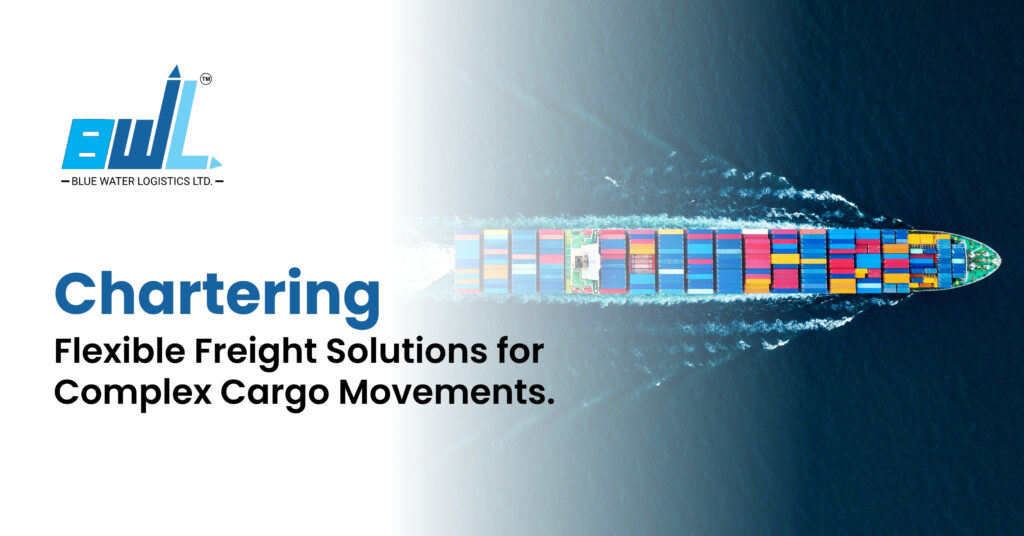
When standard shipping schedules are not enough, chartering provides the flexibility to move cargo on your terms.
In global logistics, not every shipment fits into a standard transportation schedule. Large volumes, oversized cargo, urgent consignments, project cargo, and time sensitive movements often require a more flexible approach. This is where chartering becomes an important logistics solution.
Chartering allows businesses to secure the dedicated capacity of a vessel or aircraft for transporting cargo according to specific operational requirements. Instead of relying entirely on fixed schedules and available capacity, businesses can work with a logistics partner to plan transportation around their cargo, destination, timeline, and handling requirements.
For companies managing complex supply chains, chartering can provide greater control, flexibility, and efficiency.
Chartering is the process of arranging the use of an entire vessel or aircraft, or a specific portion of its capacity, for transporting cargo.
In maritime logistics, businesses can charter vessels for bulk commodities, project cargo, heavy equipment, industrial materials, and other specialized shipments. In air freight, aircraft chartering can support urgent cargo movements, large consignments, humanitarian shipments, and time critical deliveries.
The key advantage is flexibility. The transportation solution can be planned around the shipment instead of forcing the shipment to fit into a standard transportation schedule.
Traditional freight services work well for many types of cargo. However, certain shipments require additional capacity or specialized planning.
Chartering can be particularly useful when:
For these situations, chartering can provide a more adaptable transportation strategy.
Vessel chartering is commonly used for large volume and specialized cargo movements. Depending on the cargo and operational requirements, different types of vessels may be considered.
Businesses involved in industries such as energy, infrastructure, manufacturing, construction, chemicals, and commodities may require dedicated vessel capacity for their shipments.
A chartering solution can help coordinate important elements such as vessel selection, cargo specifications, loading locations, destination ports, sailing schedules, port operations, and documentation.
For project cargo, this becomes particularly important because the shipment may include heavy machinery, industrial equipment, construction materials, or components that cannot be handled through conventional container services.
When speed is critical, aircraft chartering can provide an alternative to regular air freight services.
A dedicated aircraft can be arranged for urgent or high volume cargo movements where standard commercial flight schedules may not provide sufficient capacity or flexibility.
Aircraft chartering can support industries that depend on rapid transportation, including manufacturing, automotive, pharmaceuticals, aerospace, emergency response, and infrastructure.
The logistics provider coordinates the movement based on factors such as cargo characteristics, aircraft capacity, origin, destination, handling requirements, and delivery timeline.
Project cargo often involves complex movements that require detailed planning.
A single project may involve transporting heavy machinery from multiple locations to a construction or industrial site. The cargo may have unusual dimensions, high weight, or specialized handling requirements.
Chartering can help create a dedicated transportation plan for such movements.
Before transportation begins, logistics teams assess cargo dimensions, weight, loading requirements, route limitations, port capabilities, equipment requirements, and delivery schedules.
This planning helps reduce operational surprises and ensures that the transportation method is aligned with the requirements of the project.
Chartering is more than simply booking a vessel or aircraft. It involves coordination between multiple stakeholders.
A logistics partner can support the process from planning to execution by coordinating with carriers, ports, terminals, customs authorities, transport operators, and other service providers.
The process may include:
Having one logistics partner manage these activities can simplify communication and improve visibility throughout the shipment.
One of the biggest benefits of chartering is the ability to create a transportation solution around the specific needs of a business.
Instead of depending solely on available schedules, companies can plan transportation around project timelines and cargo requirements.
This can be particularly valuable when delays could affect production, construction, installation, or other critical business activities.
With proper planning, chartering can help businesses improve cargo movement, manage capacity requirements, and maintain better control over complex transportation operations.
Chartering requires careful planning. Businesses should evaluate several factors before selecting a chartering solution.
The type, weight, dimensions, volume, and characteristics of the cargo determine the most suitable transportation option.
Urgent cargo may require a different solution compared with cargo that can move according to a flexible schedule.
Port infrastructure, airport capabilities, route restrictions, and local transportation availability can influence the feasibility of a charter.
Heavy or oversized cargo may require specialized lifting equipment, loading arrangements, and experienced handling teams.
International shipments require appropriate documentation and compliance with applicable customs and transportation regulations.
Chartering should be evaluated based on the overall transportation requirement rather than only the initial freight cost. Capacity, handling, port operations, inland transportation, and other associated services should be considered as part of the overall logistics plan.
As global supply chains become increasingly complex, businesses need transportation solutions that can adapt to changing requirements.
Chartering provides that flexibility by allowing cargo movements to be planned around specific operational needs.
Whether it involves a vessel carrying project equipment across international waters or an aircraft transporting urgent cargo to another country, chartering can provide dedicated capacity when conventional freight options are not sufficient.
The success of a charter movement ultimately depends on detailed planning, reliable coordination, operational expertise, and effective communication.
Chartering provides businesses with a flexible approach to moving cargo that may not fit conventional transportation schedules. From vessel chartering for large and specialized cargo to aircraft chartering for urgent shipments, it can support complex logistics requirements across industries.
With the right logistics partner, chartering becomes more than simply securing transportation capacity. It becomes a coordinated logistics solution designed around the cargo, timeline, route, and operational requirements of the business.
BLUE WATER LOGISTICS LIMITED
(Formerly known as Blue Water Logistics Private Limited)
CIN No: L63030TG2022PLC165815
H NO.8-2-270/B/1/2, Block-3, 4th Floor Uptown Banjara, Road No.3, Banjara Hills, Hyderabad, Telangana, India, 500034