
Most shippers choose a freight mode by comparing two numbers: the rate and the transit time. It is a sensible start. It also leaves out the third number, which is usually the one that decides the outcome: what it costs the business when the cargo is not where it should be.
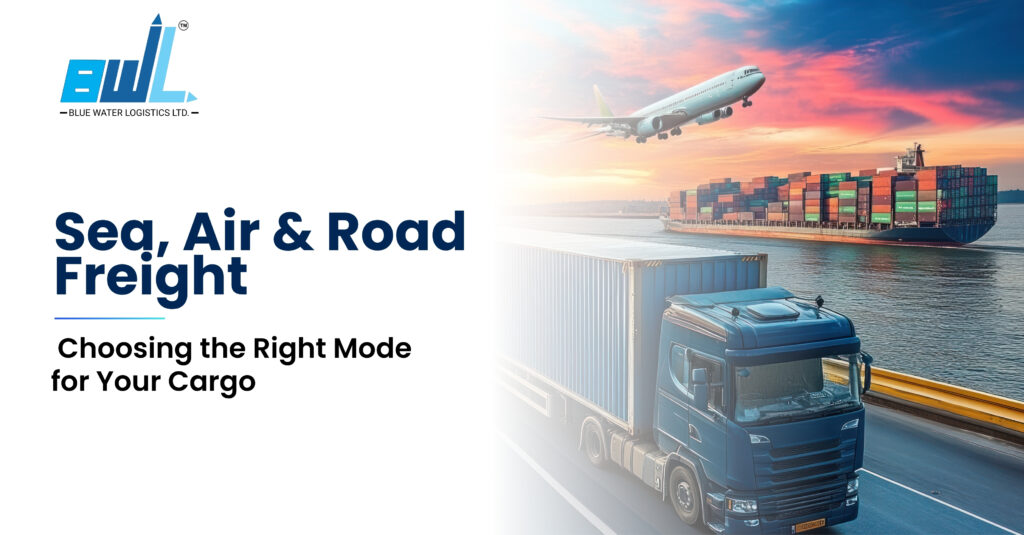
Sea freight carries volume at the lowest cost per unit. It suits heavy, bulky or non-urgent cargo, and it is the backbone of international trade for good reason. Its trade-off is time. Transit is measured in weeks, and schedules depend on ports, weather and vessel connections.
Air freight is built for speed. Cargo can cross continents in days, which makes it the right choice for time-sensitive, high-value or perishable goods. The trade-off is cost, and air freight is priced on chargeable weight, which is the greater of actual weight and volumetric weight. A light but bulky shipment can cost far more than its weight suggests.
Road freight is the flexible link. It moves cargo between factories, warehouses, ports and neighbouring countries, and it is often the only mode that reaches the final address. Its limits are distance and border crossings, where timing becomes less predictable.
A freight rate answers what it costs to move the cargo. It does not answer what it costs to wait for it.
Slow cargo ties up money. Stock in transit is stock that cannot be sold, used or invoiced, and the longer the journey, the more safety stock the business has to carry to cover it. Fast cargo costs more on the freight line and less everywhere else. Whether the trade is worth making depends on the product’s value, its shelf life and how expensive a stock-out would be.
Few shipments travel on a single mode from start to finish. Cargo leaves a factory by road, crosses an ocean by sea and reaches a warehouse by road again. Some routes combine sea and air, using one for the long haul and the other for the final leg, to balance cost against speed.
This is where coordination matters. Each handover between modes is a point where cargo can wait, and where documents and schedules have to line up.
What is the cargo worth, and what does a week’s delay cost the business? Is the shipment heavy, bulky or light, and how does that affect the chargeable weight? And what happens at each handover, from pickup to port to final delivery, and who is responsible for it?
A forwarder who works through all three with you is planning a movement, not selling a rate.
Blue Water Logistics Limited has moved cargo since 2010, as a multimodal logistics partner across sea, air and land. If you are deciding how to move your next consignment, our team will tell you plainly which mode suits the cargo, and which doesn’t.
Talk to our team → bwl.co.in/contact-us
BLUE WATER LOGISTICS LIMITED
(Formerly known as Blue Water Logistics Private Limited)
CIN No: L63030TG2022PLC165815
H NO.8-2-270/B/1/2, Block-3, 4th Floor Uptown Banjara, Road No.3, Banjara Hills, Hyderabad, Telangana, India, 500034