
When Is Chartering the Right Choice Over Scheduled Shipping?
When Is Chartering the Right Choice Over Scheduled Shipping? When Is Chartering the Right Choice Over Scheduled Shipping? Scheduled shipping works because it is predictable. Cargo goes on a published service, on a published day, alongside other shippers’ cargo. For most shipments, this is exactly what is needed. For some, it isn’t. When space is short, when the cargo is unusual or when the date cannot move, the schedule stops being an advantage and starts being a limit. What chartering actually means Chartering is hiring a vessel or an aircraft, or a defined part of it, for your cargo. Instead of buying space on someone else’s service, the shipper arranges the movement around its own cargo, route and timeline. There are different ways to do it. A voyage charter hires a vessel for a specific journey. A time charter hires it for a set period. The terms differ, and so do the responsibilities that come with them, but the principle is the same: the movement is built around the cargo, not the other way around. When scheduled shipping stops workingFour situations come up repeatedly. The first is capacity. In a tight market, scheduled space fills quickly, and cargo can be rolled to a later sailing or a later flight. For a committed delivery date, that is not an acceptable outcome. The second is cargo that doesn’t fit a regular service. Oversized, heavy or irregular consignments may not be suited to standard container vessels or regular air schedules. The third is routes. Some origins and destinations have infrequent services, or none that suit the timeline. A charter can run directly where the cargo needs to go. The fourth is urgency. When cargo is critical to a project, a production line or a customer’s deadline, control over departure matters more than the lowest rate. What chartering costs, and what it asks of you Chartering gives control and it carries responsibility. The shipper takes on the cost of the vessel or aircraft, not just the space the cargo uses, so it makes the most sense when the volume or the stakes justify it. The commercial terms, from loading and discharge time to what happens when either runs over, need to be understood before signing. It is also a decision that needs lead time. A well-planned charter is arranged around port readiness, documentation and cargo preparation, not in the last hours before departure. Three questions before you charter Is there a scheduled service that meets the delivery date, and what happens if the cargo is rolled? Does the cargo’s size, weight or urgency justify hiring the whole vessel or aircraft? And are the charter terms, especially the time allowed for loading and discharge, clear and realistic for this cargo? If the answer to the first is no, or the second is yes, chartering deserves a serious look. Moving cargo on your terms Blue Water Logistics Limited has moved cargo since 2010, as a multimodal logistics partner across sea, air and land. If you have cargo that doesn’t suit a regular schedule, our team will tell you plainly whether chartering is the right answer, and when it isn’t. Talk to our team → bwl.co.in/contact-us Get Started with BWL Today! Enquire Now
Sea, Air or Road Freight: Choosing the Right Mode for Your Cargo
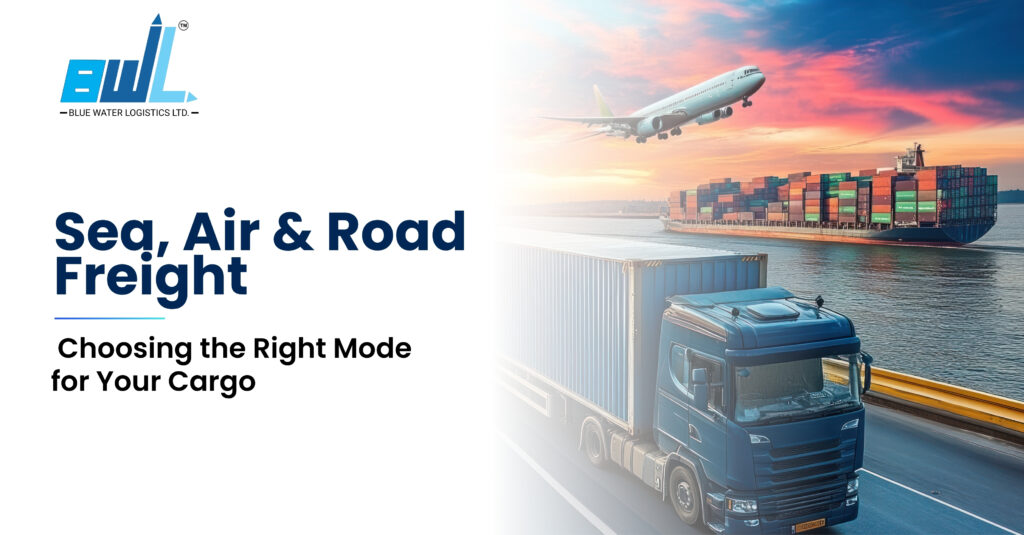
Sea, Air or Road Freight: Choosing the Right Mode for Your Cargo Sea, Air or Road Freight: Choosing the Right Mode for Your Cargo Most shippers choose a freight mode by comparing two numbers: the rate and the transit time. It is a sensible start. It also leaves out the third number, which is usually the one that decides the outcome: what it costs the business when the cargo is not where it should be. What each mode is actually good at Sea freight carries volume at the lowest cost per unit. It suits heavy, bulky or non-urgent cargo, and it is the backbone of international trade for good reason. Its trade-off is time. Transit is measured in weeks, and schedules depend on ports, weather and vessel connections. Air freight is built for speed. Cargo can cross continents in days, which makes it the right choice for time-sensitive, high-value or perishable goods. The trade-off is cost, and air freight is priced on chargeable weight, which is the greater of actual weight and volumetric weight. A light but bulky shipment can cost far more than its weight suggests. Road freight is the flexible link. It moves cargo between factories, warehouses, ports and neighbouring countries, and it is often the only mode that reaches the final address. Its limits are distance and border crossings, where timing becomes less predictable. The question underneath the choice A freight rate answers what it costs to move the cargo. It does not answer what it costs to wait for it. Slow cargo ties up money. Stock in transit is stock that cannot be sold, used or invoiced, and the longer the journey, the more safety stock the business has to carry to cover it. Fast cargo costs more on the freight line and less everywhere else. Whether the trade is worth making depends on the product’s value, its shelf life and how expensive a stock-out would be. When the answer is more than one mode Few shipments travel on a single mode from start to finish. Cargo leaves a factory by road, crosses an ocean by sea and reaches a warehouse by road again. Some routes combine sea and air, using one for the long haul and the other for the final leg, to balance cost against speed. This is where coordination matters. Each handover between modes is a point where cargo can wait, and where documents and schedules have to line up. Three questions before you choose What is the cargo worth, and what does a week’s delay cost the business? Is the shipment heavy, bulky or light, and how does that affect the chargeable weight? And what happens at each handover, from pickup to port to final delivery, and who is responsible for it? A forwarder who works through all three with you is planning a movement, not selling a rate. Moving cargo across modes Blue Water Logistics Limited has moved cargo since 2010, as a multimodal logistics partner across sea, air and land. If you are deciding how to move your next consignment, our team will tell you plainly which mode suits the cargo, and which doesn’t. Talk to our team → bwl.co.in/contact-us Get Started with BWL Today! Enquire Now
Break Bulk Handling: What Happens When Cargo Won’t Fit in a Box
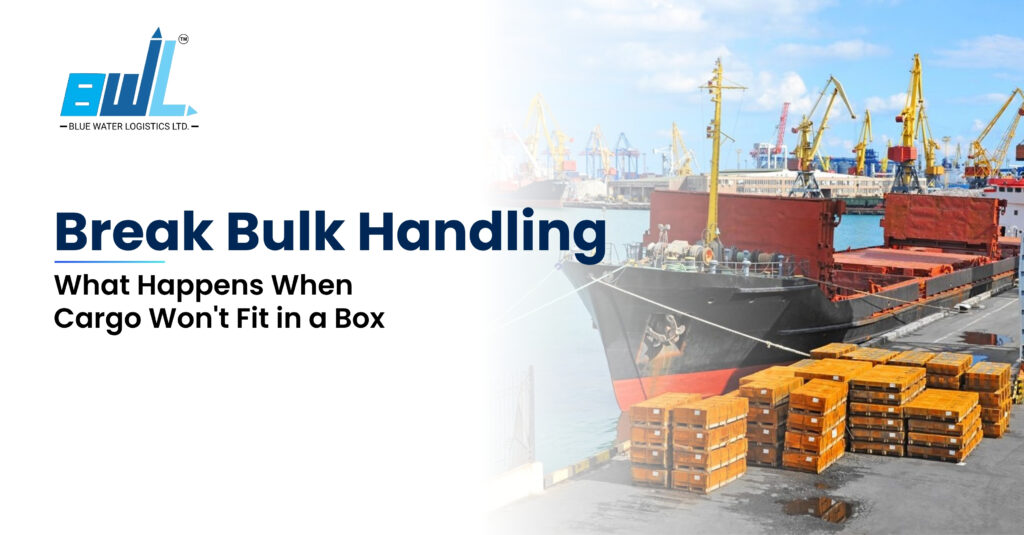
Break Bulk Handling: What Happens When Cargo Won’t Fit in a Box Break Bulk Handling: What Happens When Cargo Won’t Fit in a Box A wind turbine blade is longer than any container manufactured. A refinery vessel is heavier than any container is rated to hold. A transformer, a ship’s propeller, a pre-assembled production line — none of these were designed with a 40-foot steel box in mind, and none of them are going to be. That cargo still has to move. It moves as break bulk. What break bulk means Break bulk cargo is anything shipped individually rather than inside a container: crated, skidded, drummed, or loaded loose directly into a vessel’s hold. It is the oldest form of cargo handling in existence and, for a specific category of goods, still the only viable one. It sits alongside two neighbours that are often confused with it. Bulk cargo — grain, ore, coal — is unpackaged and loaded loose. Project cargo is a planning category rather than a handling one, referring to consignments that require bespoke engineering and route study. A single project shipment frequently moves as break bulk, which is why the terms end up used interchangeably. Stevedoring: the part that decides the outcome Stevedoring is the loading, stowing and discharging of cargo at the vessel. For containers, it is a largely mechanical process. For break bulk, it is a judgement-intensive one. Each piece needs a lifting plan. Rigging points must be identified or fabricated. Load distribution across the vessel’s deck and hold has to be calculated so the ship remains stable and correctly trimmed. Sea-fastening — the welding, chaining and bracing that holds cargo in place — has to withstand weather the voyage may or may not encounter, on the assumption that it will. None of that is improvised. A break bulk lift is planned on paper long before a crane is engaged, and the quality of that plan is what separates a routine operation from a damaged consignment. Where break bulk shipments go wrong Dimensions supplied late or approximately. Every downstream decision — vessel selection, crane capacity, route survey, port choice — depends on accurate measurements and weights. A revision at the last minute can invalidate all of it. Port capability assumed rather than confirmed. Not every port can handle every lift. Crane capacity, berth depth, laydown area and inland access road clearances all constrain what is actually possible. Route survey skipped. For cargo moving inland, bridge clearances, turning radii, overhead cables and road weight limits determine whether the consignment can physically reach its destination. This survey is not optional, and discovering its findings mid-transit is a serious problem. Documentation treated as standard. Oversized cargo attracts additional permits, escort requirements and customs attention. Clearance timelines should be planned accordingly. Planning a break bulk movement The pattern across successful break bulk shipments is consistent: early engagement, accurate data, and a partner who has handled the cargo type before. Blue Water Logistics handles break bulk and stevedoring for oversized and heavy non-containerised cargo, with specialised lifting equipment and experience across machinery, industrial plant, project consignments and construction cargo. If you have a consignment that doesn’t fit a standard box — literally or otherwise — the earlier that conversation happens, the more options remain open. Talk to our team → bwl.co.in/contact-us Get Started with BWL Today! Enquire Now
Fumigation: The Step Most Exporters Forget Until It Costs Them

Fumigation: The Step Most Exporters Forget Until It Costs Them Fumigation: The Step Most Exporters Forget Until It Costs Them Most shipments that get rejected at a foreign port are not rejected for the reason the exporter expects. The cargo is fine. The documentation for the cargo is fine. The problem is the pallet it is sitting on.6385072830 Fumigation is the least discussed stage of the export process and one of the few that can invalidate an entire consignment after it has already crossed an ocean. What fumigation is protecting against Every country regulates what crosses its border, and that regulation extends well beyond the goods themselves. Wood packaging material — pallets, crates, dunnage, bracing — can carry insect larvae, fungi and wood-boring pests. Introduced into a new ecosystem, those organisms have caused agricultural damage on a scale that has justified some of the strictest import rules in world trade. The international response is ISPM 15, a standard requiring that solid wood packaging used in international shipping be heat-treated or fumigated and marked accordingly. Agricultural cargo carries its own additional requirements, which vary considerably by destination. The three ways this goes wrong Treating the cargo and forgetting the packaging. An exporter arranges fumigation for an agricultural consignment and overlooks the untreated wooden pallets underneath it. The cargo complies. The shipment does not. Assuming one destination’s rules apply everywhere. Australia, New Zealand, the United States and the European Union each apply different thresholds and different documentation expectations. A treatment that satisfied a Gulf buyer last quarter may not satisfy an Australian one this quarter. Treating too early or too late. Fumigation certificates carry validity windows. A treatment performed well in advance of a delayed dispatch can expire before the vessel sails, leaving the exporter with a certificate that no longer covers the shipment it was issued for. Each of these is discovered at the destination, which is the most expensive possible place to discover it. What compliant fumigation actually involves The process is straightforward when it is planned and difficult when it is rushed. Cargo or packaging is sealed and treated with an approved fumigant — methyl bromide and phosphine are the most common — at a specified concentration, for a specified exposure period, at a temperature that keeps the treatment effective. The space is then ventilated to safe levels before handling resumes. A licensed operator issues a fumigation certificate recording the treatment method, dosage, duration, date and the identity of the cargo treated. That certificate travels with the shipping documents. Where wood packaging is involved, the ISPM 15 stamp must be physically present on the material itself. Exposure time and ventilation cannot be compressed to fit a dispatch schedule. Which is precisely why fumigation belongs in the shipment plan rather than at the end of it. Getting it right the first time Fumigation is not a difficult requirement. It is a requirement that fails when it is treated as an afterthought — booked in the final days before dispatch, arranged separately from the rest of the shipment, checked against last year’s destination rules. Blue Water Logistics handles fumigation as part of an integrated export process, planned alongside packaging, palletisation and customs documentation rather than bolted on at the end. For agricultural, perishable and wood-packaged cargo, that sequencing is often the difference between a shipment that clears and one that comes back. Planning an export consignment? Talk to our team → bwl.co.in/contact-us Get Started with BWL Today! Enquire Now
ISO Tank Containers: The Standard Behind Global Bulk Liquid Trade

ISO Tank Containers: The Standard Behind Global Bulk Liquid Trade ISO Tank Containers: The Standard Behind Global Bulk Liquid Trade There is a category of cargo that cannot be stacked, wrapped or palletised. It has no shape of its own. It takes the shape of whatever holds it — and everything about moving it safely across an ocean depends on what that container is made of, how it is sealed, and who last cleaned it. Bulk liquids move the chemical industry, the edible oil trade, the resin and latex supply chain and a significant share of processed food. And almost all of it, in international trade, moves in one piece of equipment: the ISO tank container. What an ISO tank container actually is An ISO tank is a stainless steel vessel held inside a rectangular steel frame built to International Organization for Standardization dimensions. That frame is the reason it works. It allows a tank of liquid to be handled by the same cranes, stacked on the same vessels and mounted on the same chassis as any standard shipping container. Capacity typically ranges between 21,000 and 26,000 litres. The inner vessel is usually 316L stainless steel, chosen because it resists corrosion from aggressive chemical cargo. Depending on the cargo, tanks may be fitted with steam heating, electric heating or insulation to hold a product within its required temperature range across a multi-week voyage. The design is deliberately unglamorous. Its entire purpose is to be uneventful. Why bulk liquid exporters choose tanks over drums The alternative to an ISO tank is to break the consignment into drums or IBCs. It is a legitimate option for small volumes, and a poor one at scale. A single ISO tank replaces roughly eighty 200-litre drums. That difference shows up in four places. Handling risk drops, because eighty individual units become one sealed movement. Product loss drops, because drums retain residue that a tank does not. Packaging cost disappears. And the disposal burden at the receiving end — eighty empty steel drums that someone must now deal with — is removed entirely. For chemical and edible oil exporters shipping recurring volumes, the economics are rarely close. The part that decides whether it goes wrong The tank itself is a solved problem. Cleaning is not. Every ISO tank carries a cleaning history. Before a food-grade or pharmaceutical-adjacent cargo is loaded, the tank must be cleaned to a specified standard and certified accordingly. The certificate matters because the previous cargo matters. A tank that last carried an industrial solvent cannot carry glucose syrup without a documented, verified cleaning cycle in between. This is where the difference between leasing and owning becomes something more than a commercial detail. Most freight forwarders lease tanks from third-party operators. When a cleaning certificate is produced, it is a document they have received rather than a process they have controlled. When tank availability tightens during a peak season, they are in a queue alongside everyone else. Blue Water Logistics owns and operates its own ISO tank fleet. That means the cleaning standard, the turnaround time and the availability of equipment are internal responsibilities, not external dependencies. For a chemical exporter with a committed vessel booking and a buyer expecting delivery, that distinction is the whole shipment. What to ask before your next bulk liquid booking Three questions separate a well-planned tank shipment from a hopeful one. What was the previous cargo in this tank, and what cleaning cycle was performed after it? Is the tank owned or leased, and what happens to my booking if availability tightens? Does the tank specification — heating, insulation, pressure rating — actually match my product’s requirements, or is it simply the tank that was free? An operator who answers all three without hesitation is an operator who has done this before. Moving bulk liquid cargo Blue Water Logistics Limited has moved bulk liquid cargo since 2010, as owner-operators of ISO tank containers and as a multimodal logistics partner across sea, air and land. If you’re planning a chemical, edible oil or food-grade liquid consignment, our team will tell you plainly what the cargo requires — and what it doesn’t. Talk to our team → bwl.co.in/contact-us Get Started with BWL Today! Enquire Now
Core Logistics Services for Every Cargo Journey

Core Logistics Services for Every Cargo Journey Core Logistics Services for Every Cargo Journey In today’s interconnected business environment, logistics is more than transporting goods from one location to another. Businesses need reliable coordination across transportation, documentation, customs, packaging, warehousing, and delivery. At Blue Water Logistics Limited (BWL), our core services are designed to bring these moving parts together, helping businesses manage their cargo efficiently across sea, air, road, and multimodal networks. BWL provides end-to-end logistics and freight forwarding solutions across sea, air, and land. 1. Sea, Air & Road Freight Every shipment has different requirements. While sea freight is suitable for large and international cargo movements, air freight supports time-sensitive and high-value shipments, while road transportation provides flexible connectivity for domestic and last-mile movement. BWL offers freight solutions across sea, air, and road, including import and export cargo and consolidation services. Whether the priority is capacity, transit time, or connectivity, choosing the right mode of transportation can make a significant difference to the overall supply chain. 2. ISO Tank Container Logistics Bulk liquid transportation requires specialized equipment, careful handling, and strong coordination. BWL provides ISO Tank Container logistics for hazardous and non-hazardous bulk liquids, including chemical and food-grade cargo. The service supports intermodal transportation across road, rail, and sea while focusing on safe and compliant movement. From cargo pickup and customs documentation to transportation and delivery, ISO Tank logistics requires every stage to work together seamlessly. 3. Project Cargo Handling Some shipments simply cannot be handled like standard cargo. Oversized, heavy, or complex shipments require detailed planning, specialized transportation, and coordinated handling. BWL provides project cargo solutions designed around the specific requirements of complex cargo movements. From planning and transportation to port coordination and delivery, project logistics focuses on managing every stage of the cargo journey. 4. FCL & LCL Cargo Not every shipment requires an entire container. Full Container Load (FCL) is suitable when a shipment occupies an entire container, while Less than Container Load (LCL) allows cargo from different consignments to be consolidated. BWL provides both FCL and LCL solutions, helping businesses select a suitable approach based on shipment size and requirements. 5. Customs Clearance International trade involves more than moving cargo. Documentation and regulatory compliance are equally important. BWL supports customs clearance through documentation preparation, shipment examination, port handling, customs procedures, and coordination for cargo movement after clearance. Efficient customs coordination helps reduce unnecessary delays and keeps the movement of international cargo on track. 6. Palletization & Export Packaging Proper packaging plays an important role in protecting cargo throughout its journey. BWL provides palletization and export packaging solutions to help prepare shipments for secure handling and transportation. These services are particularly important when cargo will pass through multiple handling points before reaching its destination. From securing individual packages to preparing cargo for export movement, the right packaging approach helps maintain cargo integrity throughout transit. 7. Fumigation For certain export shipments, fumigation is an important part of cargo preparation and compliance. BWL provides fumigation services as part of its value-added logistics portfolio, supporting the movement of cargo that requires appropriate pest-control treatment before transportation. 8. Trucking & Door-to-Door Transportation The logistics journey doesn’t end at the port. Trucking connects warehouses, factories, ports, distribution centres, and final destinations. BWL provides trucking solutions and door-to-door transportation to support seamless cargo movement across different stages of the supply chain. 9. Vessel Agency & Break Bulk Handling Efficient port operations require strong coordination. BWL’s services include vessel agency operations and break bulk handling, supporting the movement and handling of cargo that may not fit conventional containerized transportation models. One Partner. Multiple Logistics Solutions. Modern supply chains require more than individual transportation services. They require coordination between different logistics activities. From freight forwarding and ISO Tank logistics to customs clearance, project cargo, trucking, packaging, fumigation, and vessel-related services, BWL brings multiple logistics capabilities together under one network. With its focus on sea, air, land, warehousing, transportation, and distribution, BWL aims to provide businesses with dependable logistics solutions built around their specific requirements. For businesses looking for a logistics partner capable of managing different cargo requirements and transportation modes, an integrated approach can simplify the supply chain and create greater operational visibility. Get Started with BWL Today! Enquire Now
Road Freight: Connecting Every Mile of Trade
Road Freight: Connecting Every Mile of Trade Road Freight: Connecting Every Mile of Trade Road freight plays a critical role in global logistics by connecting ports, warehouses, distribution centres, businesses, and final destinations. While ocean and air freight enable long distance movement, road transportation often completes the crucial first and last mile. For businesses, reliable road freight is not simply about moving cargo from one location to another. It is about ensuring that shipments move safely, efficiently, and on schedule across every stage of the supply chain. What Is Road Freight? Road freight refers to the transportation of goods by trucks and other road vehicles. It can support a wide range of shipments, from individual consignments and containerized cargo to industrial equipment, project cargo, and time sensitive deliveries. Road freight can operate as a standalone transportation solution or as part of a multimodal logistics network connecting with sea, air, and rail transportation. Why Is Road Freight Important? Most supply chains involve multiple transportation points. Cargo may begin at a manufacturing facility, move to a warehouse, reach a port, and then continue to its final destination. Road freight connects these points. Some of its key advantages include: Flexible pickup and delivery locations Direct connectivity between facilities First mile and last mile transportation Access to locations without direct rail, sea, or air connectivity Flexible scheduling for different cargo requirements Integration with multimodal transportation This connectivity makes road freight an essential part of modern supply chains. First Mile and Last Mile Connectivity One of the most important roles of road freight is connecting the beginning and end of a shipment’s journey. First Mile First mile transportation moves cargo from the supplier, manufacturer, warehouse, or other origin point to the next stage of the logistics network. For international shipments, this could mean transporting cargo from a factory to a port or container terminal. Last Mile Last mile transportation moves cargo from a port, warehouse, distribution centre, or terminal to its final destination. This stage can have a direct impact on delivery timelines and customer satisfaction, making reliable coordination especially important. Road Freight in Multimodal Logistics Road transportation becomes even more valuable when integrated with other modes. A typical international shipment could involve: Road → Sea → Road Cargo may be collected from the origin facility, transported by truck to a port, shipped internationally by sea, and then moved by road from the destination port to the final delivery point. Similarly, urgent cargo could follow: Road → Air → Road Here, road transportation connects the shipment to and from the airport while air freight handles the long distance movement. This integration allows businesses to select the most appropriate transportation mode for each stage of the journey. Container Transportation Road freight is widely used for moving shipping containers between ports, terminals, warehouses, and industrial facilities. Container trucking requires coordination between the carrier, terminal, warehouse, consignee, and other stakeholders. Important considerations can include: Container availability Pickup and delivery schedules Route planning Terminal coordination Documentation Driver and vehicle availability Delivery timelines Effective coordination helps reduce unnecessary waiting time and keep cargo moving through the supply chain. Road Freight for Specialized Cargo Not every shipment can be transported using a standard truck. Oversized, heavy, hazardous, or specialized cargo may require specific vehicles, equipment, permits, and handling procedures. For such shipments, logistics planning becomes particularly important. The transportation team may need to evaluate: Cargo dimensions and weight Vehicle suitability Route restrictions Loading and unloading requirements Regulatory requirements Safety considerations Delivery location accessibility A properly planned road movement can help reduce operational risks while maintaining control over the shipment. What Makes Road Freight Efficient? Reliable road freight depends on more than having a fleet of vehicles. Route Planning Selecting suitable routes can help manage travel time, road restrictions, congestion, and delivery requirements. Fleet Coordination The right vehicle needs to be available at the right location and time. Shipment Visibility Tracking cargo movement allows logistics teams and customers to stay informed about delivery progress. Driver and Operational Expertise Experienced drivers and logistics teams play an important role in handling cargo safely and responding to operational challenges. Timely Communication Road transportation involves multiple moving parts. Clear communication between the shipper, carrier, terminal, warehouse, and consignee helps keep operations aligned. Road Freight and Cross Border Logistics Road freight can also support cross border transportation, where additional planning may be required. International road movements may involve customs documentation, border procedures, permits, cargo regulations, and coordination between different logistics networks. A logistics partner with experience in cross border transportation can help coordinate these requirements and reduce unnecessary delays. Choosing the Right Road Freight Solution The right road transportation solution depends on several factors: Cargo: What is being transported? Distance: How far does it need to travel? Timeline: How quickly does it need to arrive? Vehicle: What type of truck or equipment is required? Route: Are there restrictions or special requirements? Destination: Can the delivery location accommodate the vehicle and cargo? Understanding these factors before transportation begins allows businesses to build a more efficient movement plan. The Role of Road Freight in Modern Logistics As supply chains become increasingly interconnected, road freight continues to serve as the link between different transportation modes. Ports need trucks to move containers. Airports need road transportation to connect cargo with businesses. Warehouses depend on road networks for inbound and outbound movement. In this way, road freight does more than transport cargo. It connects the different stages of the supply chain. Conclusion Road freight remains a fundamental part of modern logistics because of its flexibility, accessibility, and ability to connect businesses with ports, warehouses, terminals, and final destinations. Whether it is a local delivery, container movement, cross border shipment, or part of a larger multimodal transportation plan, reliable road freight helps keep cargo moving. When every stage of the supply chain needs to stay connected, road freight provides the link that keeps the journey moving. Get Started with BWL Today! Enquire Now
Chartering: Flexible Freight Solutions for Complex Cargo Movements.
Chartering: Flexible Freight Solutions for Complex Cargo Movements. Chartering: Flexible Freight Solutions for Complex Cargo Movements. When standard shipping schedules are not enough, chartering provides the flexibility to move cargo on your terms. In global logistics, not every shipment fits into a standard transportation schedule. Large volumes, oversized cargo, urgent consignments, project cargo, and time sensitive movements often require a more flexible approach. This is where chartering becomes an important logistics solution. Chartering allows businesses to secure the dedicated capacity of a vessel or aircraft for transporting cargo according to specific operational requirements. Instead of relying entirely on fixed schedules and available capacity, businesses can work with a logistics partner to plan transportation around their cargo, destination, timeline, and handling requirements. For companies managing complex supply chains, chartering can provide greater control, flexibility, and efficiency. What Is Chartering in Logistics? Chartering is the process of arranging the use of an entire vessel or aircraft, or a specific portion of its capacity, for transporting cargo. In maritime logistics, businesses can charter vessels for bulk commodities, project cargo, heavy equipment, industrial materials, and other specialized shipments. In air freight, aircraft chartering can support urgent cargo movements, large consignments, humanitarian shipments, and time critical deliveries. The key advantage is flexibility. The transportation solution can be planned around the shipment instead of forcing the shipment to fit into a standard transportation schedule. Why Do Businesses Choose Chartering? Traditional freight services work well for many types of cargo. However, certain shipments require additional capacity or specialized planning. Chartering can be particularly useful when: Cargo volumes are too large for standard freight services Cargo requires dedicated transportation capacity The shipment has strict delivery timelines Cargo dimensions require specialized handling Standard schedules do not match project requirements Multiple consignments need to be moved together The cargo requires specific loading or unloading arrangements For these situations, chartering can provide a more adaptable transportation strategy. Vessel Chartering Vessel chartering is commonly used for large volume and specialized cargo movements. Depending on the cargo and operational requirements, different types of vessels may be considered. Businesses involved in industries such as energy, infrastructure, manufacturing, construction, chemicals, and commodities may require dedicated vessel capacity for their shipments. A chartering solution can help coordinate important elements such as vessel selection, cargo specifications, loading locations, destination ports, sailing schedules, port operations, and documentation. For project cargo, this becomes particularly important because the shipment may include heavy machinery, industrial equipment, construction materials, or components that cannot be handled through conventional container services. Aircraft Chartering When speed is critical, aircraft chartering can provide an alternative to regular air freight services. A dedicated aircraft can be arranged for urgent or high volume cargo movements where standard commercial flight schedules may not provide sufficient capacity or flexibility. Aircraft chartering can support industries that depend on rapid transportation, including manufacturing, automotive, pharmaceuticals, aerospace, emergency response, and infrastructure. The logistics provider coordinates the movement based on factors such as cargo characteristics, aircraft capacity, origin, destination, handling requirements, and delivery timeline. Chartering for Project Cargo Project cargo often involves complex movements that require detailed planning. A single project may involve transporting heavy machinery from multiple locations to a construction or industrial site. The cargo may have unusual dimensions, high weight, or specialized handling requirements. Chartering can help create a dedicated transportation plan for such movements. Before transportation begins, logistics teams assess cargo dimensions, weight, loading requirements, route limitations, port capabilities, equipment requirements, and delivery schedules. This planning helps reduce operational surprises and ensures that the transportation method is aligned with the requirements of the project. The Role of a Logistics Partner Chartering is more than simply booking a vessel or aircraft. It involves coordination between multiple stakeholders. A logistics partner can support the process from planning to execution by coordinating with carriers, ports, terminals, customs authorities, transport operators, and other service providers. The process may include: Understanding the cargo requirements Selecting the appropriate transportation solution Identifying suitable vessel or aircraft capacity Planning the origin and destination operations Coordinating loading and handling Managing documentation and compliance Monitoring the movement Coordinating final delivery Having one logistics partner manage these activities can simplify communication and improve visibility throughout the shipment. Chartering and Supply Chain Efficiency One of the biggest benefits of chartering is the ability to create a transportation solution around the specific needs of a business. Instead of depending solely on available schedules, companies can plan transportation around project timelines and cargo requirements. This can be particularly valuable when delays could affect production, construction, installation, or other critical business activities. With proper planning, chartering can help businesses improve cargo movement, manage capacity requirements, and maintain better control over complex transportation operations. What Should Businesses Consider Before Chartering? Chartering requires careful planning. Businesses should evaluate several factors before selecting a chartering solution. Cargo Requirements The type, weight, dimensions, volume, and characteristics of the cargo determine the most suitable transportation option. Timeline Urgent cargo may require a different solution compared with cargo that can move according to a flexible schedule. Origin and Destination Port infrastructure, airport capabilities, route restrictions, and local transportation availability can influence the feasibility of a charter. Handling Requirements Heavy or oversized cargo may require specialized lifting equipment, loading arrangements, and experienced handling teams. Documentation and Compliance International shipments require appropriate documentation and compliance with applicable customs and transportation regulations. Cost Considerations Chartering should be evaluated based on the overall transportation requirement rather than only the initial freight cost. Capacity, handling, port operations, inland transportation, and other associated services should be considered as part of the overall logistics plan. Chartering as a Strategic Logistics Solution As global supply chains become increasingly complex, businesses need transportation solutions that can adapt to changing requirements. Chartering provides that flexibility by allowing cargo movements to be planned around specific operational needs. Whether it involves a vessel carrying project equipment across international waters or an aircraft transporting urgent cargo to another country, chartering can provide dedicated capacity when conventional freight options are not sufficient. The success
Ocean Freight: The Backbone of Global Trade
Ocean Freight : The Backbone of Global Trade Ocean Freight : The Backbone of Global Trade In today’s interconnected world, businesses rely on efficient and cost effective transportation to move goods across international markets. Among the various modes of logistics, Ocean Freight remains the most reliable and economical solution for transporting large volumes of cargo worldwide. From raw materials and industrial equipment to consumer products, ocean freight plays a vital role in keeping global supply chains moving. What is Ocean Freight? Ocean freight is the transportation of goods via cargo ships across international waters. It is widely used for both imports and exports, offering businesses the flexibility to move everything from full container loads to smaller shipments efficiently and securely. With access to major ports worldwide, ocean freight provides a dependable solution for international trade while supporting businesses with scalable logistics options. Why Choose Ocean Freight? Cost Effective for Large Shipments Ocean freight offers one of the most economical transportation methods for bulk cargo and high volume shipments. It allows businesses to reduce shipping costs while maximizing cargo capacity. Global Connectivity With an extensive network of international ports and shipping routes, ocean freight enables seamless access to global markets, helping businesses expand their international reach. Flexible Shipping Options Businesses can choose between: Full Container Load (FCL) – Dedicated containers for large shipments. Less than Container Load (LCL) – Shared containers for smaller consignments, offering a cost effective solution without requiring a full container. Safe and Secure Transportation Modern shipping containers are designed to protect cargo from external conditions during transit. Advanced tracking systems also provide greater visibility throughout the shipping journey. Environmentally Responsible Compared to air freight, ocean freight produces significantly lower carbon emissions per ton of cargo, making it a more sustainable option for international transportation. Industries That Depend on Ocean Freight Ocean freight supports a wide range of industries, including: Manufacturing Automotive Chemicals Pharmaceuticals Retail and Consumer Goods Agriculture Food and Beverage Engineering and Heavy Equipment Factors to Consider Before Shipping To ensure smooth international transportation, businesses should evaluate: Type of cargo Shipment volume Delivery timelines Customs documentation Packaging requirements Destination port regulations Partnering with an experienced logistics provider helps simplify these processes while minimizing delays and ensuring compliance with international shipping standards. Why Partner with Blue Water Logistics? At Blue Water Logistics, we provide comprehensive ocean freight solutions designed to meet diverse business requirements. From shipment planning and documentation to customs coordination and final delivery, our experienced team ensures efficient cargo movement across global shipping networks. Whether you require Full Container Load (FCL), Less than Container Load (LCL), or specialized cargo handling, we deliver reliable, transparent, and customer focused logistics solutions that keep your business connected to the world. Navigate Global Trade with Confidence Ocean freight continues to be the preferred choice for businesses seeking reliable, scalable, and cost effective international shipping. With the right logistics partner, companies can streamline operations, optimize supply chains, and expand confidently into global markets. Conclusion As global trade continues to evolve, ocean freight remains one of the most dependable, cost effective, and sustainable solutions for international cargo transportation. Its ability to efficiently move large volumes of goods across continents makes it an essential component of modern supply chains. By partnering with an experienced logistics provider, businesses can ensure seamless shipping, regulatory compliance, and timely deliveries while optimizing operational costs. At Blue Water Logistics, we are committed to delivering reliable ocean freight solutions tailored to your business requirements. Whether you’re shipping full container loads, smaller consignments, or specialized cargo, our expertise, global network, and customer focused approach help you navigate international trade with confidence. Partner with Blue Water Logistics and experience efficient, secure, and hassle free ocean freight services that keep your business moving forward. Get Started with BWL Today! Enquire Now
Customs Clearance: The Key to Smooth International Trade
Customs Clearance : The Key to Smooth International Trade Customs Clearance : The Key to Smooth International Trade In today’s interconnected global economy, international trade plays a vital role in business growth. Every day, millions of shipments cross international borders, carrying goods that power industries, support businesses, and meet consumer demand. However, before these goods can enter or leave a country, they must undergo a critical process known as Customs Clearance. Customs clearance is much more than paperwork. It is a structured process that ensures shipments comply with a country’s import and export regulations, allowing cargo to move legally and efficiently across borders. A well-managed customs clearance process minimizes delays, reduces costs, and keeps supply chains running smoothly. What is Customs Clearance? Customs clearance is the process of obtaining permission from customs authorities for goods to enter or leave a country. It involves verifying shipment details, assessing duties and taxes, and ensuring compliance with all applicable trade regulations. Whether transporting raw materials, finished products, or specialized equipment, customs clearance is an essential step in international logistics. Why Customs Clearance Matters Efficient customs clearance offers several advantages for businesses engaged in international trade. Ensures Regulatory Compliance Every country has its own customs regulations, import restrictions, and documentation requirements. Proper customs clearance ensures shipments comply with these rules, avoiding legal complications and shipment delays. Reduces Transit Delays Incomplete documentation or incorrect declarations can result in cargo being held at ports or border checkpoints. Timely customs clearance helps shipments move quickly through customs, ensuring faster delivery. Controls Logistics Costs Unexpected delays often lead to additional storage charges, demurrage, and operational expenses. Efficient customs management helps businesses avoid these unnecessary costs. Supports Supply Chain Efficiency Smooth customs procedures improve inventory management, production planning, and customer satisfaction by ensuring predictable delivery schedules. The Customs Clearance Process A successful customs clearance process involves several important steps. 1. Documentation Review The first step is preparing and verifying all required shipping documents, including: Commercial Invoice Packing List Bill of Lading or Air Waybill Import or Export Licenses Certificate of Origin Insurance Documents (where applicable) Accurate documentation helps prevent processing delays. 2. Customs Declaration Shipment details are submitted electronically or manually to customs authorities for review. This declaration includes cargo description, value, quantity, classification, and destination. 3. Duty and Tax Assessment Customs officials calculate applicable import duties, taxes, and other government charges based on the shipment’s classification and declared value. 4. Cargo Inspection Depending on the shipment, customs authorities may conduct physical inspections or document verification to ensure compliance with regulations. 5. Customs Release Once all requirements have been met and duties have been paid, customs authorities release the shipment for onward transportation. Common Challenges in Customs Clearance International shipments can encounter several challenges during customs processing. Some common issues include: Incorrect or incomplete documentation Incorrect HS Code classification Delayed duty payments Changing import and export regulations Customs inspections Restricted or prohibited goods Non-compliance with country-specific requirements Working with experienced customs professionals significantly reduces these risks. Benefits of Professional Customs Clearance Services Partnering with a knowledgeable logistics provider offers numerous advantages. Faster customs processing Accurate documentation management Compliance with international regulations Reduced risk of shipment delays Better cost control Expert guidance on import and export procedures Seamless coordination with shipping lines and government authorities Professional customs support allows businesses to focus on their core operations while ensuring uninterrupted cargo movement. Why Choose Blue Water Logistics? At Blue Water Logistics, we understand that efficient customs clearance is essential for successful international trade. Our experienced team manages every aspect of the customs process with accuracy, transparency, and compliance. Our customs clearance services include: Import and export customs clearance Documentation preparation and verification Duty and tax guidance HS Code classification assistance Regulatory compliance support Cargo coordination with ports and customs authorities End-to-end shipment assistance With extensive industry experience and a customer-first approach, we help businesses move cargo across borders efficiently while minimizing delays and ensuring full regulatory compliance. Conclusion Customs clearance is one of the most critical stages in international logistics. A well-executed customs process ensures that goods move across borders efficiently, remain compliant with regulations, and reach their destinations on time. As global trade continues to expand, businesses need logistics partners who understand the complexities of customs procedures and can navigate changing regulations with confidence. Blue Water Logistics combines industry expertise, efficient processes, and personalized service to deliver reliable customs clearance solutions that keep your supply chain moving without interruption. Get Started with BWL Today! Enquire Now